
I Want A Divorce But Don’t Know Where My Spouse Lives

First of all, if you find yourself in the predicament of wanting to get a divorce but not knowing where your spouse lives you are not a lone.

At Divorce661, we have many clients who call us and say this exact thing. Usually, it is due to a long term separation where they just lost communication with each other.

Sometimes they are short marriages, perhaps a Vegas style marriage, and then they lost touch and other times it is spouses married 20 plus years who separated and started living apart and then, what do you know 10 years went by.

It happens more than you think so if this is what happened to you, don’t feel like you are the only one.

But here is the deal. You are going to have to find out where your spouse is if you want to get a divorce in California.

Yes, there are ways of asking the court to “publish” your divorce case and avoid actually serving them, however the barrier to getting the approval from the court to do that is often a long process and one which where if you do all the things the court will require you to do to approve the “service by publication” you will likely find them anyways.

In my opinion it is best to just spend the time to locate them. This is for several reasons. First, when trying to publish your divorce, the court is going to make you jump through all kinds of hoops. They are going to make you call all the numbers you have for your spouse, their relatives, send letters to old addresses, call family members, check social media, even hire a private investigator.

By the time you have done all of this, you might as well have actually done the work to locate them.

Then, once you do all the things the court will require for you to locate them, you have to file a petition with the court to show all the things you did and only after they approve your efforts can you file by publication.

Then you have to publish your divorce in a local newspaper where they last lived which at a minimum will cost $2oo. ( that is the cheapest we have found for LA County)

Then, once it has been published in the paper, you can consider them served.

This process adds at a minimum, 3 months to the California divorce process, usually longer and is more costly.

So my advice is to just do the work to locate your spouse for your divorce. It is much faster and less expensive than trying to serve your divorce by publication.

I get a lot of calls where people have done some research online and don’t want to go to the trouble of contacting their spouse and think the service by publication is the answer.

Well, it is not.

Locate your spouse so we can properly serve and finalize your divorce. At the end of the day it will make the California divorce process faster and less expensive.

Spousal & Child Support Modifications | California Divorce | Divorce 661

Spousal & Child Support Modifications | California Divorce | Divorce 661

If you need to modify spousal support or child support after your California divorce has finalized, known as a post judgment modification, there are a few reasons you can do this. For purposes of this article and video we are talking about modifying support based on a change in one parties income.


To file a motion or Request For Order as it is known to request a change in either spousal support or child support, there needs to be a change in circumstances. A change in one’s income is a suitable change in circumstances to file a motion to request the court modify support.

But, before you run out and go through the court process to file a motion to modify support, I always advise my clients to first attempt to figure it out on their own, outside of court.

For example, lets say that the payor spouse (the one paying) has their income reduced say due to a change of employer or perhaps they took a job out of state that paid less. I would recommend you first speak with your ex spouse and let them know the reason and need to reduce support.

Of course they will not be happy with receiving less, however one way or another, if your income has changes, the courts will likely reduce the support anyways, so might as well do it the easy way.

First thing you should do is give me a call so i can run the numbers through the court’s dissomaster software to see what the new support amount may be. Then you can take a copy of the printout and show your spouse and if you guys agree to the new numbers then it is just a matter of preparing a stipulation and order regarding the modification of support.

This is a much better way than having to go through the courts.

What To Do With Your House During California Divorce

What To Do With Your House During California Divorce

When going through a divorce in California you will need to decide what to do with your home. There are only a few options you have. Sell, Buyout or Keep. I explain what you need to consider in this video. (More Below Video)

I have found that with many divorce cases I handle in California, that many times one spouse wants to keep the house. This seems to be their hope even when it does not make sense financially in some circumstances.

Let’s explore the options with your home during a California Divorce

Sell The Family Home

Probably the easiest way to deal with the family home during a divorce is just to sell it. If you have equity in the home you can split the proceeds which may give you the needed “getting started” money to move and either purchase a new home or to have the money to put down on a rental.

In most cases it is likely that the family home is more home than one person needs unless there are children involved which you may want to keep in the home.

One Spouse Keeps The Home

I have had numerous clients work out a deal where both spouses decide to keep the house with one of them staying in the home. This is usually done when there are minor children still in the house and the parents want to maintain continuity for the children and stay in the home until they have at lease graduated high school and then they will sell the home at that time.

Buyout Of Family Home

The last option is a buy out of the home. In this case one of the spouses is deciding to stay in the home and have it confirmed as their sole and separate property. This is possible by either refinancing the loan into their own name and taking some cash out for the buyout.

In the alternative, if refinancing is not an option, perhaps there is another asset such as a 401k or pension that can offset the value that should come from the home.

For instance, let’s say that there is $100,000 in equity in the family home. So each spouse would get $50,000 if the home was sold. If one spouse wanted to keep the home, look for another asset that may offset this.

Let’s say that the spouse not keeping the house has a 401k with $50,000 in it. Well, in this case the spouse with the 401k could keep the entirety of it and the spouse could keep the home and the asset division is equal.

You don’t have to sell everything in a divorce. You can use equity from all assets to work towards an agreement that is fair to both of you.

FL-150 : How To Avoid Filing FL-150 During California Divorce :: Divorce661

FL-150 : How To Avoid Filing FL-150 During California Divorce

When you go through a divorce in California, there are many divorce forms you will have to complete. But the type of divorce process you are going through, (Contested, Uncontested or Hybrid) will dictate which set of divorce forms you will use and file.


Many of the divorce forms are the same for each of the types of divorce, however in certain types of divorce cases, some forms are filed and some are not.

The purpose of this article is to address one such topic which is how to avoid having to file the FL-150, income and expense declaration.

Now first you may be asking yourself why someone would want to do this. The only reason that has been presented to me is that some clients don’t want to have all their financial information filed with the court and thus part of public record with the courts.

If you have seen the FL-150 income and expense declaration you can see it does have plenty of personal information on it. Such as, how much you make, the name of your employer, when you last filed taxes as well as a list of all your expenses. There is a lot of information that goes on the FL-150 and I can see why some people would not want this part of public records that someone could come across or purposely look for.

All of this has to do with procedure. In some cases, for instance if you have minor children, the income and expense declaration must be filed if you have a default with agreement style case, but is not necessary when you have an uncontested divorce case (petition filed and response filed)

So in this case with my clients, they were going to have to file their FL-150 and they asked if there was a way to avoid having to file it with the court. The answer was to have the Respondent file a Response despite the fact that they are in full agreement. This prevents them from having to file the FL-150 with the court, but just remember you still need to complete it as part of the disclosure process.

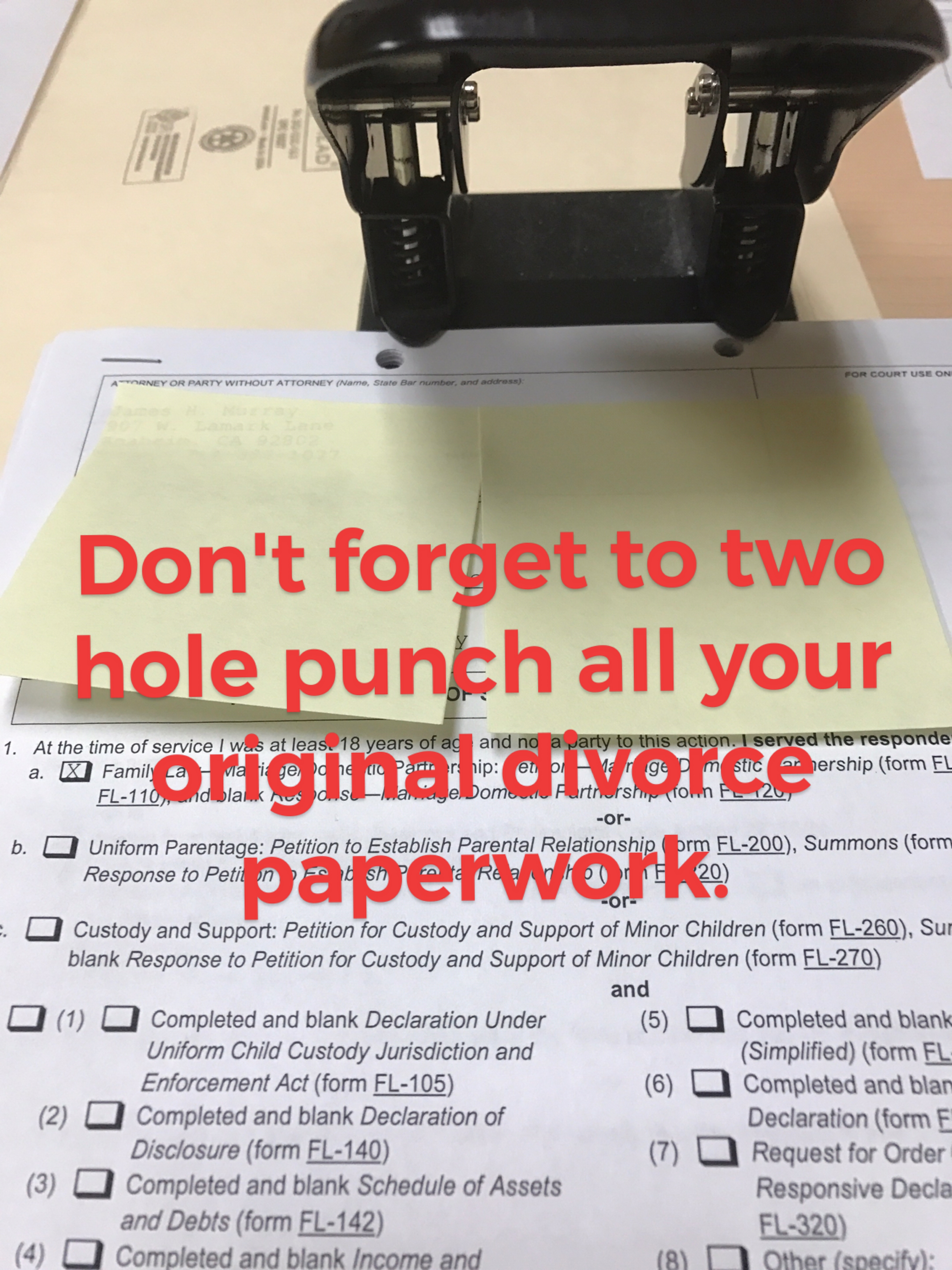
California Divorce | Two Hole Punch All Original Documents | Divorce 661 Tip Of The Day

California Divorce | Two Hole Punch All Original Documents | Divorce 661 Tip Of The Day #Divorce661TipOfTheDay

The California divorce courts require your original divorce documents to be two hold punched. This let’s them know it is an original document and makes it easier for them to enter your forms into the case file with the court. If you don’t have your original documents two hole punched, they will reject the filing.

 
Two Hole Punch All Original Divorce Documents

Notarize Your California Divorce Judgments | Divorce661 Tip Of The Day

Notarize Your California Divorce Judgments | Divorce661 Tip Of The Day | #Divorce661TipOfTheDay

So I decided to do some shorter format divorce tips in addition to the videos, long form articles, podcast and social media posts. So what you can expect, in addition to all that, is a quick daily tip and a photo with some helpful piece of advice.

So here is todays Divorce 661 Tip Of The Day.

 
Divorce 661 Tip Of The Day

To avoid delays with finalizing your divorce judgment, both parties should have their divorce judgment notarized. We have a “judgement attachment” form that we use that already has the acknowledgment in place for the notary to be able to notarize your California Divorce Judgment

child support, spousal support

Modify Support For California Divorce? Run A Dissomaster First | Divorce661

Modify Support For California Divorce? Run A Dissomaster First | Divorce661

I get a lot of calls where people want to modify child support or modify spousal support for their California divorce.

This is all fine and well, but the first thing you want to do is make sure it is going to end up in your favor.

What I have found is that people just assume that by filing a motion to modify child support or spousal support that they will receive more or less in support based upon their gut feeling. Maybe they found out their spouse is earning more now and assume they should get more in support.

There are several things you have to consider, and while I won’t get into everything, I will provide a few examples.

Let’s say you have been receiving support for a few years both in child support and spousal support. Let’s assume that you come to learn that your spouse is now earning more money and thus your rationale for requesting more support.

Now in many cases, this would be simple and the justification for the request for additional support is based on a change in circumstances, that being one of the parties is earning more income.

But some other factors you need to look at is how has your income changed. As it has been several years, has your income gone up as well? When you ask for more in child support, will you spouse take that opportunity to ask for more custody and thus also affect the amount of support you receive or pay?

These are just some of the additional things you need to look at in addition to just how much income each of you receive.

And as I stated in the video above, at least 50% of the time when we run the numbers we learn that support would go down (for those who wanted to raise it) and go up ( for those trying to lower it)

I am happy to spend a few minutes on the phone with you to go over your situation to see if it would make sense to file a motion to modify child support and / or spousal support.

Motion To Set Aside Default : California Divorce Default Set Aside Motion

Motion To Set Aside Default : California Divorce Default Set Aside Motion

This article, video and podcast explains what you need to do if the Petitioner has filed a Request To Enter Default with the California divorce court and the default has been entered.

When this happens, you lose your opportunity to file a Response and be part of the divorce case. However, there are steps you can take to ask the court to set aside the default so you can file your Response.  There are only a few reasons you can state for asking the court to set aside the default on your divorce case so you can enter your response. (read more below video and podcast)

This issue can occur if you wait longer than 30 days to file your Response. At any time after 30 days of you being served the Divorce Petition, the Petitioner can file a Request To Enter Default which will prevent you from filing your Response.

If you need assistance with filing a Request To Set Aside the Default, please give me a call. I can assist you with filing the Request For Order asking the judge to set aside the default and help you file your Response as well so you can participate in your own divorce case.

The Only Bad Reviews We Have Are From Non-Clients!

We live in a world now where anybody can leave a review for a business on such sites as Yelp, Google and Facebook.  It is just what we, as business owners, have to deal with on a regular basis.

What strikes me as interesting is that people get bent out of shape for some of the simplest of issues.

As of this writing we have about 33 or so reviews on Yelp. We have mostly 5 stars given to us by our clients.

However, we do have some 1 star ratings, but these have been written by people who are not even our clients, never would be our clients and who seem extremely rude and plain old nasty.  Some are people that had contact with our company such as scheduling a consultation or leaving a message with us, and others are just straight out made up accounts with the intent to disparage our company.

The purpose of this article is to try to understand why people, who are not our clients, go out of their way to write negative reviews. Some go as  far as to take screenshots and write multiple paragraphs filled with anger, insults and rude comments.

The most recent came from a lady who set up a consultation using our website. I was unable to call her due to a family emergency at her scheduled time. That is all that occurred. I didn’t call her when she requested!

She was so irate that she wrote multiple negative reviews filled with hate, anger, rudeness and personal insults. All that happened is that I was unable to call her!

I am not perfect and on occasion may miss a call or be unable to call due to circumstances outside my control. I even sent her a personal email to let her know of my family emergency and you know what she said? She responded by saying that she did not believe me.

All I can say is that I am so glad this person NEVER became a client of ours. I think the heavens were protecting me from this insanity and could only imagine if I had to deal with this person by assisting her with her divorce. Thank god I was unable to make the call.

I think people need to look at themselves as to why they are so angry with their life that they have to try to make others miserable.

For me, I try to steer clear of these super nasty, angry people. I don’t need them in my business or my life.

And yes, this was a rant. I am airing my thoughts here as opposed to writing a nasty response to these people. Nothing will come of it but further frustration and insanity.

The customer is not always right. Oh, sorry, these people NEVER were our clients!

California Divorce FL-150 : Do You Have To File The Income & Expense Declaration

Being that I help people with their divorce in California every day, I do come across many clients who started their divorce on their own and then later call me to fix and finalize their divorce paperwork.

One of the common things I see is that people are filing the FL-150 income and expense declaration with the court when they don’t have to.

Here are the rules. Yes, you need to prepare an income and expense declaration, form FL-150, however you only have to file the FL-150 in a handful of situations. So this article will address when you need to file the income and expense declaration form FL-150 and when you don’t.

In addition, I will tell you how to avoid having to file the income and expense declaration if you want to avoid having to do so. (Read more below the video)


So when do you have to file the income and expense declaration form FL-150?

1. When there are minor children involved (unless uncontested case)
2. When a Response is filed.
3. When you have a true default case.

But what if you don’t want to file an income and expense declaration with the court because you don’t want your financials to be part of your divorce case and subject to being part of public record.

The reason I wrote this article and created the above video is because I get asked all the time if divorce records are public record. And the answer is yes. This is why we provide such little information (only what is required by the court) when it comes to drafting our divorce settlement agreements.

But when the income and expense form is required to be filed, such as when there are children involved, the question is how can you avoid having to file the FL-150?

The answer is quite simple and I already gave the answer away in the the list above.

If you are going through divorce in California and have children, you will have to file an income and expense declaration with the court. But, you only have to file the FL-150 if your case is what we call a default with agreement or true default.

If your California divorce case is considered an uncontested divorce (defined as the Petitioner filing the petition and the Respondent filing a Response) you do not have to file the income and expense declaration with the court.

So for purposes of this article, i was asked by a client how to avoid having to file the FL-150 income and expense declaration with the court. The answer was, “File a Response and you don’t have to file the FL-150 with the court”.

So if you are concerned about putting out all your personal information out there for the world to potentially find, one way to avoid filing the FL-150 is simply to have the Respondent file a Response.