
Using Substituted Service Of California Divorce Papers

Using Substituted Service Of California Divorce Papers

This video discusses what service by substituted service, when you would use it and how it works. Substituted service of your California divorce papers is usually a last resort and can only by achieved in certain circumstances.

There are several ways to serve a divorce petition in California. First, you have “personal service” This is where you have someone other than yourself personally deliver the divorce petition to the person being served and they are handed the papers. This can be a friend, relative or in many cases a 3rd party process service that can handle this for you.

Another route in amicable divorce cases is to simply have the the other party sign a Notice Of Acknowledgment of Receipt. This is an easy way to let the courts know that the other party was served or in this case, that they have acknowledged receiving a copy of the filed divorce papers.

But what happens when the person you are trying to serve is either unavailable or, what is more likely, trying to avoid being served?

We have this happen once and a while and the only way to serve them is usually by substituted service.

Substituted service, often referred to as “sub-served” is the practice of serving someone other than the person being served. So you are serving someone such as another family member or even a person of a business they work at such as their employer or even a front end person like the receptionist.

I can think of two such instances that just this week we had to serve by substituted service. The first was a Respondent to the divorce case who was trying to avoid being served for whatever reason. We found out where he worked (on Facebook no less) and were able to sub-serve him there. In this case we were able to serve his boss once it was determined that he did work there.

Another instance was a young man who was purposely avoiding being served to be a nuisance. The servers tried to serve him several times, and despite being able to hear him in the house and garage, he would not present himself to be served.

In this case, they went back late at night, when his parents were home and served his parents who verified that he lived there.

No there are specific rules you have to follow in order for a sub-service to be valid with the courts. The short story is that you have to make several documented attempts at serving and only then can you sub serve. But even then, you have have to write a special declaration that explains the steps you took to actually serve the other party. The court has to approve your steps in order for the substituted service to be valid.

When we know service may possibly be an issue, we always use a 3rd party professional process server as they know how to properly document the substituted service of the divorce papers in a way that will be approved.
California Divorce Judgment Rejected? This Is Why!

There are many reasons your California Divorce judgment paperwork will be rejected. In fact, there are 3 pages of reasons why your California Divorce judgment may be rejected.

But the main reason your judgement papers get rejected is because when you turn in your divorce judgment package to the court, this is the first time anybody is actually reviewing your documents. (Continue reading below video)


When you turn in your divorce judgment, that is the first time the court is reviewing even your initial court documents such as your summons and petition and whether you know it or not, if you did something wrong on the divorce petition, you wouldn’t know it until you turned in your judgment.

Now, while your divorce judgment can be rejected for many reasons, generally the court will review and provide you with a list of reasons why your divorce judgment paperwork is being rejected.

But, they won’t tell you what the correction is. They will just tell you what is wrong with it.

And for the first time in my life, I have seen a reject sheet that didn’t even provide the reasons why the judgment was rejected. If you watched the video, i showed you a reject sheet from a clerk that basically said the paperwork was so messed up that they weren’t going to go to the trouble of providing all the reasons why it was being rejected.

In fact, the divorce judgment reject sheet simply said that there were too many issues and many missing documents and to seek legal advice on how to prepare their divorce.

That is exactly what this person did. They hired us to review and correct and finalize their divorce case. Now, while the clerk was correct and there were many missing forms and errors, i just thought it was so lazy of the clerk to not even provide the reasons why it was rejected.

If you need assistance with your divorce judgment paperwork please give us a call. Correcting California divorce paperwork is our speciality. Or, just save yourself some trouble and hire us before you ever file a single divorce form.

You will save yourself a lot of wasted time and grief.

How To Request Zero Child Support Order For California Divorce

How To Request Zero Child Support Order For California Divorce

Whether through my full service divorce clients or through our online do-it-yourself tutorials at California Divorce Tutor, it is a popular request that people do not want to have child support as part of their California divorce. Mostly people say they want to address the needs of the children, including child support, outside of  court just like they did when they were married. Essentially, they don’t want a child support order stating what they have to pay.


With child support and requesting that there be no child support, the thing that you are up against is that child support is mandatory in California. However, there is a way to package up your California divorce to request no child support as part of your divorce. You just have to do it a certain way.

So this video will show you what forms and what language you need to in order to achieve a no child support order divorce.

We provide both a full-service divorce solution across California or you are trying to save some money and have plenty of time on your hands, you can always elect to use our do-it-yourself videos at California Divorce Tutor. We have a solution for everyone.


My Anti-Valentine’s Day 2017 & Dinner At Whole Foods

My wife and I have been married for 22 years and while it has not been all rainbows and unicorns we have stuck it out with each other. I don’t mean for that to sound negative, but you know what I mean.

One thing my wife and I both dislike is what we called “Forced Holidays”. This would include Valentine’s Day!

I get my wife flowers and we go to dinner often, probably more often that we should. So I don’t like it when I am told that on a certain day each year i need to go out to dinner with the masses on a weekday (usually) and purchase over priced flowers just so we can post pictures on Facebook of the flowers and show all our friends how awesome our marriage is.

Yeah, no. I told my wife we would not be doing that this year…. And she agreed.

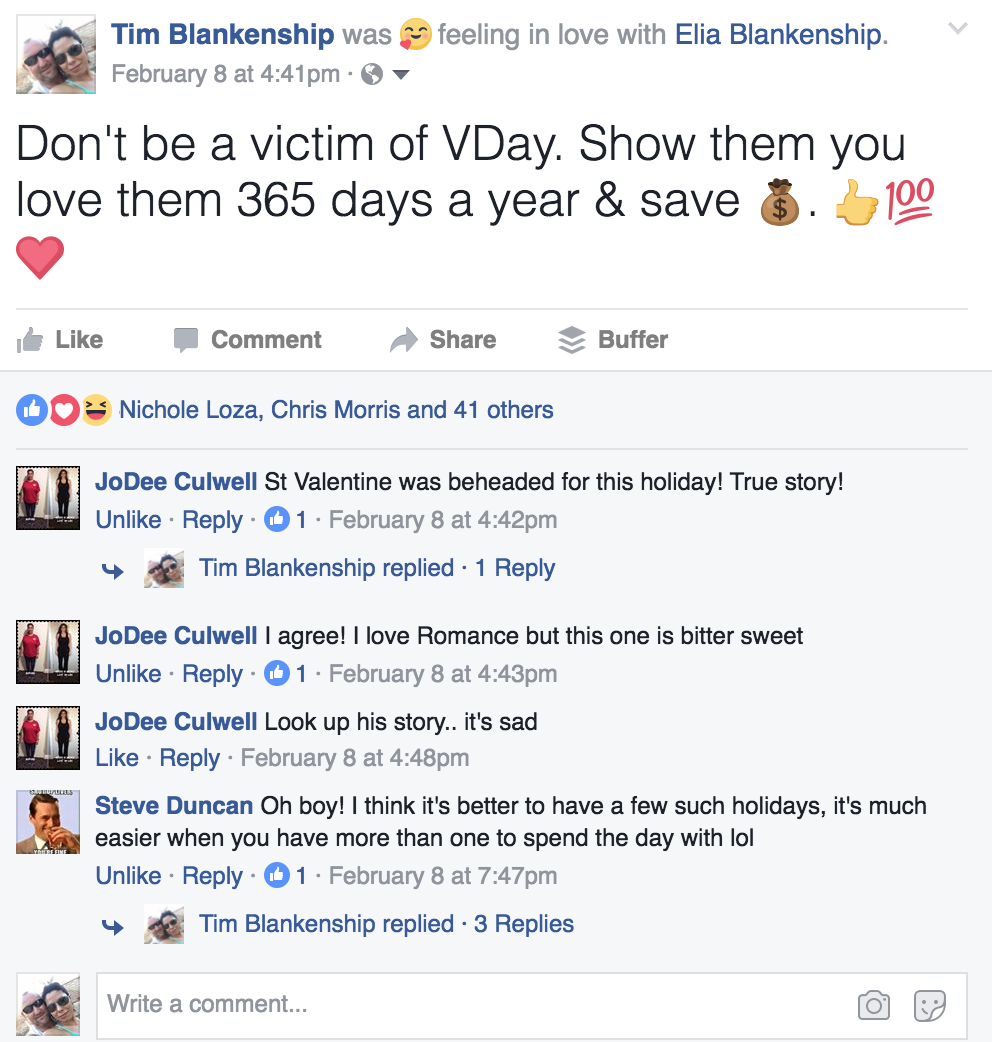
I even posted on Facebook how i felt about it.

Pre Valentine’s FB Post

So I took it a bit further.

This year we had:

  • No Flowers
  • No Card
  • No Dinner (sort of)

So we agreed that we would disagree with Valentine’s Day 2017 and instead put a little money away. Instead of going on a forced dinner and spending money on overpriced flowers we just put a few hundred dollars in our savings account. The money we would have probably spent on dinner and flowers.

My wife did surprise me, however, in that she came home from running errands brought us some sushi from Whole Foods.

So that was it for us. Sushi from Whole Foods and in bed watching a movie by 9. That is my kind of evening.

California Divorce Ex-Parte Must Be True Emergencies

The way Divorce Ex-Parte hearings are being decided are changing. I am seeing a trend where Judges are making sure that the divorce Ex-Parte hearings are true emergencies.

I have sent several clients down to court on Divorce Ex-Parte hearings lately and I have noticed a trend. The judges are being more critical of the Ex-Parte hearings and if they are not true emergencies, they are denying the Ex Parte hearing.


What is troubling about this is that the bar for being a true emergency is getting higher and higher. Before, financial difficulties were considered emergencies. The last client i sent in Ex Parte was told by an attorney that they had a good Ex-Parte divorce issue in that they were about to be evicted because the spouse moved out of the rental home and stopped paying the rent while the wife was at home with the 2 kids and coming up on Christmas is facing eviction. Despicable!

In any case, we sent her down on emergency Ex Parte motion to get her rent caught up and the judge denied it flat out.  Even the attorney that referred this client to us was shocked that they did not consider the matter since she was about to be evicted.

I make a joke that unless there is “blood on the floor” which my mom would say while telling a story and she realized nobody was listening, the ex parte hearings are not being heard.

Additionally, before the judge would deny the ex parte hearing, but then set the matter on the regular calendar, now they are denying the ex parte hearing and telling the party who filed to file their case on the normal calendar.

The issue here is that if the judge continued the ex parte hearing and set a new date, the court fees the person paid would be considered paid. By the court denying the ex parte hearing and not continuing the hearing or setting is on the calendar forces the party filing the ex parte to pay the filing fees twice.

This is not fair.

Let me explain… So you have an emergency you feel warrants an ex parte motion. You file the motion Ex parte and it is denied. You paid your fees for that hearing, but because the judge felt it did not warrant an emergency, you have to re-file completely and pay the fees again which can be as much as $115 each time.

Sometimes, just not fair…

We handle Request For Orders both on the regular calendar and Ex-Parte. Please call for a free phone consultation to discuss your situation.

California Divorce Judgment Rejected | FL-141 Missing Or Wrong

California Divorce Judgment Rejected | FL-141 Missing Or Wrong

Having your California divorce case rejected is never fun. However, this article will discuss what to do if your California divorce judgment is rejected for the following reasons listed on the FAM-001.

Judicial Council form FL-141, Declaration Regarding Service of Declaration of Disclosure & Income and Expense Declaration [revised July 2013]

  1. must be submitted by the Petitioner as to the Preliminary Declaration of Disclosure (the Preliminary Declaration cannot be waived). See Family Code §2104.
  2. must be submitted by the Respondent as to the Preliminary Declaration of Disclosure (the Preliminary Declaration cannot be waived). See Family Code §2104.
  3. must be submitted by the Petitioner & the Respondent as to the Final Declaration of Disclosure & Income and Expense Declaration; in the alternative, the parties may stipulate to a mutual waiver of the requirements of 2105(a) concerning the final declaration of disclosure by execution of a waiver under penalty of perjury by separate stipulation by filing Judicial Council form FL-144, Stipulation and Waiver of Final Declaration of Disclosure [revised January 2007]. Please refer to Family Code §§2105, 2106.

This is a common error and is easy to fix. Most people forget about the form altogether, but when the form is submitted to the court the biggest problem is that people forget to fill in the date.

You see where it says on paragraph one that either the Petitioner or Respondent has served the other party their preliminary declaration of disclosures?  And then there is some white space between paragraph one and paragraph two? There is where you are supposed to put the date that the disclosures were served.

As usual, it is a poorly formatted form and just begs for mistakes to be made. Thankfully it is an easy fix, but is cause for rejection of your California divorce judgment.

When The Divorce Court Wants Your Matter Set For Hearing

When The Divorce Court Wants Your Matter Set For Hearing

Okay, this is another article about helping you with issues related to submitting your divorce judgment in California. This article discusses what to do if the court rejects your judgment and advised you to set the your divorce case for a hearing using form FAM-031.

Listen to the podcast where I explain in detail why you received this notice and what you need to do.

The FAM-031 is a form you use to set your case for a hearing. The reject letter you receive that has this section marked simply means that the court found something in your divorce judgment that they have a question on and they want you to come to court so they can ask you about it.

We see this happen mostly on default divorce cases. Default divorce cases, either default with agreements or default without agreements also known as a true default.

Here is what you do…

File the request for default setting form FAM-031 and check off the boxes that apply. They will usually say what the issue is that will relate to one of the check boxes on the request for default setting form.

The most common issues and reasons we see the court setting hearing is as follows:

  1. You are trying to terminate spousal support on a long term marriage
  2. You are asking for a specific amount of support
  3. Request for no child visitation or supervised visitation
  4. Request for child support either for more or less than what the court would order
  5. Any other reason… If the court states the specific issue then use the “other box” If you don’t know the reason then use the “other box” and write “per court request”

Having your divorce judgment rejected is very frustrating and learning you now have to wait for a hearing (which can be as much as 90 days off or longer) will likely not make you happy especially considering you were opening the package from the court thinking your divorce case was finalized, only to learn it is not.

Please call us if you would like assistance with your divorce case.

California Divorce & Children | Will I Have To Go To Court

If you have children and are going through a divorce, will you have to go to court? Put another way, if you have children is going to court mandatory?

I was asked this the other day of a new client of ours who said she had heard from a friend who went through divorce that if you have children, you have to go to court.

This is not the case.

As with any other issues you need to settle as part of your California divorce, the only reason you would have to see a judge or go to a court hearing is in the event you do not agree. Because we are always discussing the amicable approach to divorce in California, i will answer this questions like i do all others.  The only reason you will ever go to court is in the event you and your spouse do not agree.

The same applies to when you have children and going through a divorce in California.  The courts don’t want you in their courtroom unless you ask to to have your matter heard by a judge which is called a hearing or trial.  Just because you have kids does not mean that court is mandatory.

When going through a divorce in California, the children are just one more part of the puzzle that needs to be figured out between the parties.  You will need to come up with a parenting plan of sorts. This may be a full parenting plan where you and your spouse account for every minute of every day of your children’s custody schedule or can be as simple as indicating to the court that you and your spouse will have joint legal and joint physical custody of the children.

Most of our clients decide that they do not want the court’s involvement in their divorce. Meaning, they prefer not to have specific child custody orders in place so they can have the flexibility in their parenting. Many of our clients do this because they do not feel it necessary to memorialize or put into writing how they are going to handle the child custody situation.

You can decide to have a detailed child custody schedule or you can simply say that the parties will make the decisions regarding the child custody and visitation on an ongoing basis in the best interest of the children.

Most people re surprised to know that it can be this simple when it comes to children and divorce, but it is just that simple. Or i should say, can be that simple if you want it to be.

Stipulating (Agreeing) Vs. Litigating California Divorce Matters

The word stipulate means “to agree” to something.  I get lots of calls where people want to modify, change, or create new orders related to their divorce both during the divorce proceeding or years after their divorce has been finalized.

There is a misconception that in order to have these orders changed that you have to go to court and see the judge.  This is not true and would be best explained with an example.

I had a guy call this week that said he wanted to file a motion to go to court so he could reduce his child support.  His income had gone down, while his former spouse’s had gone up.  His change in circumstances warranted making a change to the child support.

He was calling us because he had contacted an attorney who wanted $4,500 to file the motion and represent him for this action.  When he spoke with me, the first thing I asked him is if his spouse would agree to make the changes without having to go to court.

I told him that in cases where the numbers don’t lie, such as in this case using a dissomaster calculation (what the court’s use to calculate support) it is worth a shot to contact his former spouse and just explain it to her cordially to see if they can come to an agreement without having to go to court.

I told him to simply state the facts.  That his income has gone down and hers has gone up and per a new calculation the child support should be changed.

He then asked me why the attorney he spoke to would not have mentioned this tactic.  My answer was that there is no money to be made by parties that are in agreement.  They would rather suggest a course of action that drives in the most revenue for their law firm, essentially doing what is best for them and not their clients.

Make sure to grab your copy of my book while your at it. There is a lot of great information and you will learn a lot about divorce.

Moved From Orange County To Los Angeles : Where To File Your Divorce Case

When you are going through a divorce or about to start your divorce and you move, especially move to different county, you are going to have to decide where you want to file your divorce case. Keep in mind that there are ruled of where you can file as discussed below.

We had new clients that fell into this situation. They lived in Orange County where they were selling their home and in the meantime, both spouses moved to Los Angeles County. The problem the occurs here is that on the divorce Petition form FL-100, it states that at least one of the spouses in the divorce has to have lived in the State of California for at least 6 months and lives in the County they are filing for divorce in at least 3 months immediately prior to filing for divorce in that County.

So the question became where do we file their divorce case? In Los Angeles or Orange County? Here is what was decided and why. They had lived in Orange County for some time and had their primary residence there. Even though they have moved out of Orange County recently, they had most recently lived in Orange County for the 3 months prior to filing for divorce. Another problem that there was is that it would be difficult to file for divorce in Orange County using Los Angeles County addresses. The courts would call that into question.

So what we did is had them use their current address in Orange County so we could file the case in Orange County now. The other thing we could have done is wait the 3 months to file their divorce case in Los Angeles County. But as you can probably guess, waiting was not something that they wanted to consider. So we are filing their divorce case in Orange County.

I wanted to write and article and shoot a quick video on this because many folks find themselves moving either prior to starting their divorce or after filing their divorce. If you move out after filing for divorce, that does not change anything with the courts. Just make sure to complete a change of address with the court.

Where you live is only a concern when move prior to filing for divorce.

Just remember. Per the divorce Petition, you must live in California for 6 months and in the County for 3 months prior to filing for divorce in that county.